Visual Workforce Blog
How Skills Planning Can Enhance M&A Synergies
Integrate Skills Inventory into the Virtual Data Room to gain a clear understanding of the workforce's skills. Bain's studies show its the path to successful outcomes.

Mergers and Acquisitions (M&A) offer an effective strategy for companies looking to enhance their competitive advantage and bottom line. According to the Institute of Mergers, Acquisitions and Alliances, in the first half of 2024, the value of M&A deals rose by 5%, overall transaction volume fell by 30%. Deal volumes were just over 21,000 and deal values reached $1.3tn so far in 2024. Bain & Co’s mid year recap shows global M&A deal value up 21% over 2023 and is on track with 2023 totals.
These numbers show us that the financial stakes of M&As are higher than ever, and the importance of achieving post-merger synergies is vital to the long-term success of the companies involved.
Unfortunately, successful M&A deals are the exception, not the standard. Research by Christensen, Clayton updated the research and published in the Harvard Business Review in 2019 - the failure rate is between 70 percent and 90 percent.
How can you ensure your company is the exception?
Bain & Company: In a study on post-merger integration, Bain found that companies with a clear understanding of their workforce's skills and capabilities were more likely to achieve successful outcomes.
McKinsey & Company: McKinsey has emphasized the importance of skills based organizations in the context of digital transformation, arguing that such organizations are better equipped to adapt to new technologies and market trends.
Key points to consider:
Clear understanding of workforce skills and capabilities is crucial for successful post-merger integration, execution and ROI.
Skills based organizations are better positioned to adapt to changes and market shifts.
Recent studies emphasize the importance of talent intelligence by focusing on people and talent development during mergers and acquisitions.
Integrating Skills Inventory into the Virtual Data Room (VDR)
A Virtual Data Room (VDR) is a secure online platform used to share confidential documents during M&A transactions. By incorporating a detailed skills inventory into the VDR, companies can provide potential acquirers with valuable insights into their workforce, enhancing the overall due diligence process and increasing the likelihood of a successful deal.
Key Benefits of Including a Skills Inventory in the VDR:
Transparent Assessment of Talent: A workforce skills inventory provides a clear and comprehensive overview of the target company's workforce. This allows potential acquirers to assess the quality and availability of talent, identify potential synergies, and evaluate the company's ability to execute its post-merger strategy.
Enhanced Due Diligence: By providing access to a skills inventory, companies can streamline the due diligence process and reduce the time and resources required to gather information. This can help to expedite the deal and increase the chances of a successful outcome.
Improved Negotiation Leverage: A well-documented skills inventory can give the target company a competitive advantage in negotiations. By highlighting the value of its workforce, the company can potentially negotiate better terms and conditions.
Facilitated Integration Planning: A skills inventory can help to identify potential integration challenges and opportunities. By understanding the skills and competencies of the combined workforce, companies can develop effective integration plans to minimize disruption and maximize synergies.
Reduced Post-Merger Risks: By providing a clear picture of the workforce, a skills inventory can help to reduce the risk of post-merger challenges such as employee morale issues, turnover, and decreased productivity.
Key Considerations for Including a Skills Inventory in the VDR:
Data Privacy and Security: Ensure that all sensitive employee data is handled in accordance with applicable privacy laws and regulations. Implement robust security measures to protect the confidentiality of the information contained in the skills inventory.
Accuracy and Completeness: Ensure that the skills inventory is accurate, up-to-date, and complete. This will provide potential acquirers with a reliable assessment of the target company's workforce.
Accessibility: Make the skills inventory easily accessible to potential acquirers within the VDR. Consider using a user-friendly format, such as a searchable database or interactive tool.
Customization: Tailor the skills inventory to the specific needs of the M&A transaction. This may involve highlighting certain skills or competencies that are particularly relevant to the deal.
By integrating a skills inventory into the VDR, companies can provide potential acquirers with a valuable tool for assessing the quality and availability of talent, enhancing the due diligence process, and increasing the likelihood of a successful M&A transaction.
Workforce skills inventory and skills based organizations have become increasingly important in the context of successful M&A. They offer a strategic advantage by:
Enhancing due diligence: A comprehensive skills inventory can provide valuable insights into the target company's workforce, helping acquirers assess potential synergies and risks.
Facilitating post-merger integration: By identifying skills gaps and strengths, companies can develop effective integration plans and ensure a smooth transition.
Driving innovation and agility: Skills based organizations can foster a culture of innovation and adaptability, which is essential in today's rapidly changing business environment.
Improving employee engagement and retention: By recognizing and rewarding employees based on their skills and contributions, companies can enhance employee satisfaction and reduce turnover.
Related Posts: How do you build a skills matrix?
Recent research and case studies have highlighted the benefits of incorporating skills inventory and skills based principles into M&A strategies and synergies.
What Are Synergies?
A synergy “arises in a merger or acquisition when the combined value of the two firms is higher than the pre-merger value of both firms combined.” The most common types of synergies are “cost-saving” and “revenue-upside” synergies.
Cost-saving synergies focus cost reductions, due to efficiencies from combining the businesses. Revenue-upside synergies are achieved through incremental revenues acquired through the merger.
There are other factors besides revenue and cost that generate synergies and can significantly impact the success of a merger. Such factors are often overshadowed by these more apparent activities that directly contribute to the bottom line and the value of the acquisition. However, these “soft” synergies play a crucial role in the sustainability and long-term success of a merger.
Arguably the most significant “soft” synergy is people. So many companies miss the mark when it comes to developing and executing a successful workforce integration strategy. Another study from the Harvard Business Review showed that companies with “especially large cultural mismatches saw their yearly net income drop by over $600 million.”
Here’s the bottom-line: People can make or break your M&A deal.
How Can You Focus on People to Improve Synergies?
Align Skills and Capabilities. By evaluating and recognizing the strengths and weaknesses of both workforces, executives can align skills and capabilities to enhance synergies. For example, Company A’s workforce may be strong in a particular skill set that Company B lacks and vice versa. By filling existing gaps, both companies experience greater operational efficiencies that generate positive cost-saving synergies.
Identify Key Managers and Employees To Lead. Selecting a capable management team to lead both companies through this transformation is critical to obtaining buy-in from your workforce. You need to choose the right people with the right skills from both companies. While some of these skills are merger-specific “hard” skills, most are “soft” skills such as leadership, communication, problem-solving, and adaptability.
Evaluating potential candidates for your management team shouldn’t be an informal process. Leveraging data-driven evaluation will ensure you blend the right mix of experience and skills to form a team that can lead your workforce through a successful transformation.
Related Post: The Best Way to Track and Identify Your Team’s Hard and Soft Skills
Prioritize Culture Integration Along with skills, successfully merging cultures can create long-term synergies for a new company. However, this can be one of the hardest things to achieve post-acquisition, especially for companies with significantly different cultures. Before the acquisition, executives should evaluate differences in-depth to see if the two cultures are compatible. If they choose to move forward, this analysis will serve as a strong foundation for a strategic plan to merge the cultures successfully.
Retain Top Talent The last result you want from a merger is to lose the top talent you just acquired. These people may be responsible for achieving several synergies. Losing them could be a massive blow to the success of your merger. By taking the actions noted above, you can avoid a mass exit of top talent and even leverage their individual skills and capabilities more as a combined force.
How Can Skills Planning Help You Achieve Successful Workforce Integration?
Skills planning provides you a clear snapshot of your current workforce’s skills and capabilities. The approach will help you recognize the strengths of your workforce as well as any skills gaps. An excellent skills planning tool will allow you to collect and analyze data efficiently so you can focus on leveraging any insights to make better business decisions.
Successful workforce integration begins with understanding both side’s strengths and weaknesses. From this data, you can recognize opportunities for synergies in skills gaps. Merging each workforce should help close these gaps, not expand them.
Your skills planning tool should also utilize data visualizations to reveal these gaps clearly and quickly. For example, the graph below shows all skills for the IT department, compared to the ideal standards for those skills:
Notice how you can immediately identify the gaps and the strengths of your combined workforce. Now rather than scouring excel spreadsheets for the answers, you can spend valuable time developing an effective strategy from these insights.
Skills planning should be performed prior to acquisition and post acquisition. Activities like selecting the merger leadership team may occur post acquisition. You can leverage skills planning on a smaller scale to identify the right people with the right skills for the position.
After the new company emerges from the transformation stage, skills planning can become a recurring activity used to strengthen and expand your workforce, identify high performing teams for projects, and win competitive bids.
Talent Management and Post-Merger Integration:
Skills based assessments: Companies are using skills inventories to assess the capabilities of their combined workforce and identify potential synergies.
Talent retention: Skills based organizations can help to retain key talent by providing opportunities for career development and growth.
Cultural integration: A focus on skills can help to bridge cultural differences and promote a unified organizational culture.
Digital Transformation and M&A:
Upskilling and reskilling: Skills inventories can help to identify the skills gaps that need to be addressed to support digital transformation.
Agile organizations: Skills based organizations are often more agile and adaptable to change, which is essential to achieving value.
Sustainable talent management: Skills based organizations can focus on developing the skills needed to support sustainable business practices.
Related Posts: What Are the Business Benefits of Having a Skills Inventory?
M&As provide opportunities for companies to expand beyond their current potential. However, key synergies must be realized to reap the long-term benefits of a merger. Skills planning can help you achieve synergies from workforce integration. Your people are your greatest asset. By strategically aligning your workforce’s skills and capabilities, you set your new organization up for long term success beyond the initial M&A deal.
Ready to invest in the future of your workforce?
Learn how Visual Workforce can help you discover and optimize the skills and capabilities of your people, teams, and projects.
Visual Workforce is the software solution at the heart of the creation, operation, and competitive advantage of a Skills Based Organization (SBO).
Related Posts
How To Prioritize Human Capital in M&A Due Diligence
Mergers and Acquisitions are complex. Evaluating and deciding how two organizations will transform into a single successful venture requires comprehensive due diligence. This involves investigating everything from financial records to business models to intellectual property.
Yet, there’s one element of prospective companies that often gets deprioritized during this rigorous process. People.

Mergers and Acquisitions are complex. Evaluating and deciding how two organizations will transform into a single successful venture requires comprehensive due diligence. This involves investigating everything from financial records to business models to intellectual property.
Yet, there’s one element of prospective companies that often gets deprioritized during this rigorous process. People.
People, or human capital, are the most important asset of any organization. They are also the most complex and unfortunately the cause of many failed M&A deals.
Bain & Company: In a study on post-merger integration, Bain found that companies with a clear understanding of their workforce's skills and capabilities were more likely to achieve successful outcomes.
McKinsey & Company: McKinsey has emphasized the importance of skills based organizations in the context of digital transformation, arguing that such organizations are better equipped to adapt to new technologies and market trends.
Acquiring a company soon? In this article, we’ll discuss why and how you should prioritize human capital in your due diligence process.
Where Does Human Capital Fit In The Due Diligence Process?
Conducting due diligence is not just about checking financial statements and projections. It’s about gaining a strong understanding of the business model. At the end of the process, you should have a way to measure the potential synergies, scalability, and operational efficiencies of stemming from the M&A deal.
The keyword here is “measure.” Items like financial statements, intellectual property, and inventories provide measurable data that seamlessly translates into monetary value. However, data on skills, experiences, and proficiencies have traditionally been more ambiguous and difficult to label with a clear value.
Today, there are cutting-edge tools that automatically baselines human capital assets, their hard and soft skills, and their professional experiences through real-time data that’s presented in a powerful, visual way.
Here’s how you can leverage these tools to produce measurable skills data to better inform your valuation.
Add Skills Data To The Data Room
There are two locations buyers and advisors conduct due diligence. In the data room and on-site.
Traditionally, the on-site visit is used to evaluate culture, environment, business management, and labor. Nearly all human capital due diligence is conducted on-site.
On-site visits are usually the final step in the evaluation process, which means human capital is not assessed as core data of the business.
Include skills data on all workforces in the virtual data room (VDR). Both parties should develop an up-to-date skills inventory that provides accurate skills data on all employees in the workforce. This data informs the valuation of technology assets, new products and markets, and operational efficiencies.
Key Benefits of Including a Skills Inventory in the VDR:
Transparent Assessment of Talent: A workforce skills inventory provides a clear and comprehensive overview of the target company's workforce. This allows potential acquirers to assess the quality and availability of talent, identify potential synergies, and evaluate the company's ability to execute its post-merger strategy.
Enhanced Due Diligence: By providing access to a skills inventory, companies can streamline the due diligence process and reduce the time and resources required to gather information. This can help to expedite the deal and increase the chances of a successful outcome.
Improved Negotiation Leverage: A well-documented skills inventory can give the target company a competitive advantage in negotiations. By highlighting the value of its workforce, the company can potentially negotiate better terms and conditions.
Facilitated Integration Planning: A skills inventory can help to identify potential integration challenges and opportunities. By understanding the skills and competencies of the combined workforce, companies can develop effective integration plans to minimize disruption and maximize synergies.
Reduced Post-Merger Risks: By providing a clear picture of the workforce, a skills inventory can help to reduce the risk of post-merger challenges such as employee morale issues, turnover, and decreased productivity.
Key Considerations for Including a Skills Inventory in the VDR:
Data Privacy and Security: Ensure that all sensitive employee data is handled in accordance with applicable privacy laws and regulations. Implement robust security measures to protect the confidentiality of the information contained in the skills inventory.
Accuracy and Completeness: Ensure that the skills inventory is accurate, up-to-date, and complete. This will provide potential acquirers with a reliable assessment of the target company's workforce.
Accessibility: Make the skills inventory easily accessible to potential acquirers within the VDR. Consider using a user-friendly format, such as a searchable database or interactive tool.
Customization: Tailor the skills inventory to the specific needs of the M&A transaction. This may involve highlighting certain skills or competencies that are particularly relevant to the deal.
Leverage Skills Data to Evaluate Post-Merger Synergies
Human capital influences more than cultural synergies. Like we mentioned above, the skills and capabilities of your future workforce influence technology, costs, performance and so much more.
Why? Because people execute the business strategy.
Evaluating skills data during the due diligence process can expose critical skills gaps that threaten the success of post-merger synergies.
For example, Company A is looking to acquire Company B, a small startup, for its unique, cloud-based technology. The technology will increase system productivity by 200% and allow Company A to expand into new product markets. Based on traditional data, acquiring Company B is a great strategic decision with long-term financial benefits.
However, let’s now include real-time skills data into Company A’s due diligence. After using data visualizations to easily interpret the results, it turns out Company A’s workforce does not have the right skills to integrate their existing systems with Company B’s cloud-based technology.
If skills data is included in due diligence, Buyers can proactively evaluate how each workforce will influence post-merger synergies and the overall valuation of the M&A deal. In turn, they will spare themselves extensive costs, inefficiencies, and potentially a failed transaction.
At the end of the day, your goal is “don’t leave money on the table.” M&A transactions are already complex and buyers will inherently incur significant risk. True profits lie in the long-term success of the deal. Therefore, every factor should be evaluated based on measurable, actionable data to mitigate this risk and set your M&A deal up for post-transaction success. Start leveraging tools like Visual Workforce to turn ambiguous human capital into measurable skills data that will inform your overall valuation.
Ready to win the human side of M&A? Start leveraging skills data today with Visual Workforce.
Learn how Visual Workforce helps you automate the discovery and optimization of the skills of your people, teams, and projects to help you easily evaluate human capital in your next M&A deal.
Related Posts
Top 5 Skills Needed For Cloud Transformation
Discover the essential skills matrix your workforce needs for successful cloud transformation. Learn how to prepare your team for the future of tech and avoid costly delays in your digital journey
Introduction
Cloud computing has arrived in full force, and it's here to stay. Businesses are looking to capitalize on cloud infrastructure.
Public cloud services end-user spending worldwide was forecast to reach $1.04 trillion in 2025, growing at a compound annual growth rate (CAGR) of 23.7% from 2021 to 2025
For 2024, IDC forecasts cloud infrastructure spending to grow 19.3% compared to 2023 to $129.9 billion
Long-term, IDC predicts spending on cloud infrastructure to have a compound annual growth rate (CAGR) of 12.8% over the 2023-2028 forecast period, reaching $199.1 billion in 2028
Shared cloud infrastructure spending is expected to account for 71.8% of total cloud spending in 2028, growing at a 12.8% CAGR and reaching $143.0 billion
Spending on dedicated cloud infrastructure is expected to grow at a CAGR of 12.9% to $56.1 billion by 2028
Federal IT budget for cloud computing reached $83 billion in FY 2025
Yet a recent study found that nearly three quarters of IT decision makers (71%) believe their organizations have lost revenue due to a lack of cloud expertise. Where’s the disconnect?
Technology continues to spread at a rapid pace, but our workforce is struggling to adapt. People are not learning new skills fast enough, slowing down cloud adoption that's costing companies in lost time and revenue.
Are you preparing to move your company to the cloud? Make sure your workforce is tooled up to make the transition.
We've researched and compiled the top 5 cloud skills your workforce needs for a smooth transformation:
Top 5 Cloud Skills Your Workforce Needs Now
1 | Cloud Security
While there is an abundance of cloud vendors, security is still the responsibility of the organization. Providers typically operate under a shared responsibility model meaning businesses cannot solely rely on vendors to ensure top-level cloud security.
Your IT teams need to have the skills to maintain all aspects of cloud security. To keep your organization is protected, your team should learn how to utilize various cloud security tools offered by popular vendors like Amazon Web Services (AWS) and Microsoft Azure.
2 | Database Management
The world produces nearly 2.5 quintillion bytes of data created every day. That is a ton of data businesses need to process and manage. Due to its favorable scalability, the cloud has become the preferred location to store data collected by companies.
Knowing how to store, manage, and access data stored in the cloud are essential skills your IT professionals should have to execute a sustainable cloud strategy. Without these skills, it's nearly impossible to derive insights that drive better business outcomes. Employees should also have a working knowledge of key database languages like SQL, MySQL, and Hadoop.
3 | AI & Machine Learning
The cloud offers companies the opportunity to leverage big data to improve their business operations and outcomes. However, business leaders need an efficient way to gain insights from large quantities of data that drive business decisions. Artificial Intelligence techniques provide new ways to find answers fast.
As you consider deploying AI technologies that complement your cloud infrastructure, make sure your workforce is trained in the necessary AI techniques. You do not necessarily need the capability to develop in-house AI solutions but, you do need the skills to utilize and maintain vendor solutions.
4 | Cloud Migration
Enterprises are pushing to migrate their applications to a full cloud or hybrid systems as fast as possible. Yet, when they finally make the move their businesses only use select features without fully adopting the cloud due to challenges caused by significant skills gaps.
Why is it crucial for employees to have skills in cloud migration? Cloud migration has its own risks and is not an easy process. The goal for organizations is to migrate their applications and operations to the cloud while fully complying with the business' security, infrastructure, and environment requirements. Your business needs to be able to smoothly transition all of these factors from its original infrastructure to the new cloud-based infrastructure. This process requires its own unique set of hard and soft skills.
Improper migration processes often lead to business downtime and data vulnerability. Before you begin the migration process, you will want to ensure that your team has working knowledge across multiple cloud platforms, like AWS, Azure, or Google Cloud.
5 | Container Support
As a part of cloud migration, many organizations are adopting container technology. Containers are more agile than their traditional counterparts. According to The Annual Container Adoption Survey, containers allow companies to easily "virtualize applications, develop and deploy microservices, which makes operations more efficient by default."
Your cloud professionals should know how to leverage multiple container tools that allow them to deploy and manage cloud solutions in real time. Such tools include Docker, Amazon ECS, Google Container Engine, Azure Container Service, Kubernetes.
Is Your Workforce Prepared for the Cloud?
Now that you know which skills are essential for cloud transformation you need to identify whether or not your workforce has these skills.
You need a tool that can help you identify gaps in your workforce. Skills planning is designed to provide a snapshot of the current skills and capabilities of your workforce. This productive tool can help quickly determine if your workforce is ready for a cloud transformation. Once you've addressed any skills gaps, skills planning can also help you visualize and manage the changes your workforce undergoes as they adopt new cloud skills.
Implementing cloud infrastructure requires a heavy uplifting of tools, processes, and skills. If you want to see profitable results from your transformation efforts, check that your workforce is prepared to make the transition. Don’t let a skills gap slow you down. Plan ahead, identify your gaps, and strengthen your skills and capabilities before you make your move to the cloud.
Ready to invest in the future of your workforce?
Learn how Visual Workforce can help you discover and optimize the skills and capabilities of your people, teams, and projects.
The Surprising Reason Why Your Digital Transformation Could Fail
The phrase digital transformation has become a regular buzzword in the business world. Organizations are gearing up to incorporate new technologies like cloud infrastructure, AI, and the Internet of Things, all promising new operational efficiencies and competitive advantages.
CEOs referring to "digital" in their strategic plans increased from 2.1 percent in 2012 to 13.4 percent in 2018. It's not all talk either. Gartner predicts worldwide IT spending is projected to total $3.8 trillion in 2019, an increase of 3.2 percent from expected spending of $3.7 trillion in 2018. Those are some significant, expensive commitments to change.
The phrase digital transformation has become a regular buzzword in the business world. Organizations are gearing up to incorporate new technologies like cloud infrastructure, AI, and the Internet of Things, all promising new operational efficiencies and competitive advantages.
A recent report by Gartner predicts that by 2025, 80% of enterprise workloads will be migrated to the cloud, up from 15% in 2019. This rapid shift signifies a fundamental transformation in how businesses operate, particularly within the finance department. Gartner predicts worldwide IT spending is projected to grow 7.5% in 2024, reaching $5.26 trillion. Those are some significant, expensive commitments to change.
It's not all smooth sailing. Even with all of the right intentions to change, 84% of digital transformations fail (forbes). Business leaders recognize the need for digital, but the scarcity of successful execution reflects a different reality.
If the world is on board with digital, why do we see a staggering number of failed attempts?
Mind The Digital Skills Gap
Digital transformations require intricate strategic planning across finances, operations, and implementation. Adopting new technology can alter entire systems and processes, an expensive investment in time and money. Business leaders need to ensure their plan is valid given this considerable investment.
But, there is another factor business leaders tend to deprioritize or forget, their people. Your employees are in charge of implementing, operating and maintaining new technologies. This often requires new skills and capabilities. Do your employees have the skills to manage a cloud-based system? How about artificial intelligence?
A recent Cloud Industry Forum survey illustrated that 25% of organizations believe that a digital skills shortage is preventing or delaying them from successfully executing their digital transformation strategy. A staggering 81% of CIOs believe they need to recruit new staff to obtain the skills they require.
There will always be a learning curve associated with change. However, these statistics represent the complexity of modern technologies that often require more extensive training and education, leaving organizations with a shortage of top talent.
In a recent paper, Digital Abundance and Scarce Genius, Seth Benzell and Erik Brynjolfsson refer to this issue as the productivity paradox. The paradox claims our workforce is not learning the necessary skills fast enough to keep up with the rate that new technology is spreading, leading to a decline in productivity.
For the next 3 years, Skills Management is slated to be the #1 HR Tech Investment as stated by HR Leaders according to Gartner 2024 HCM Trends.
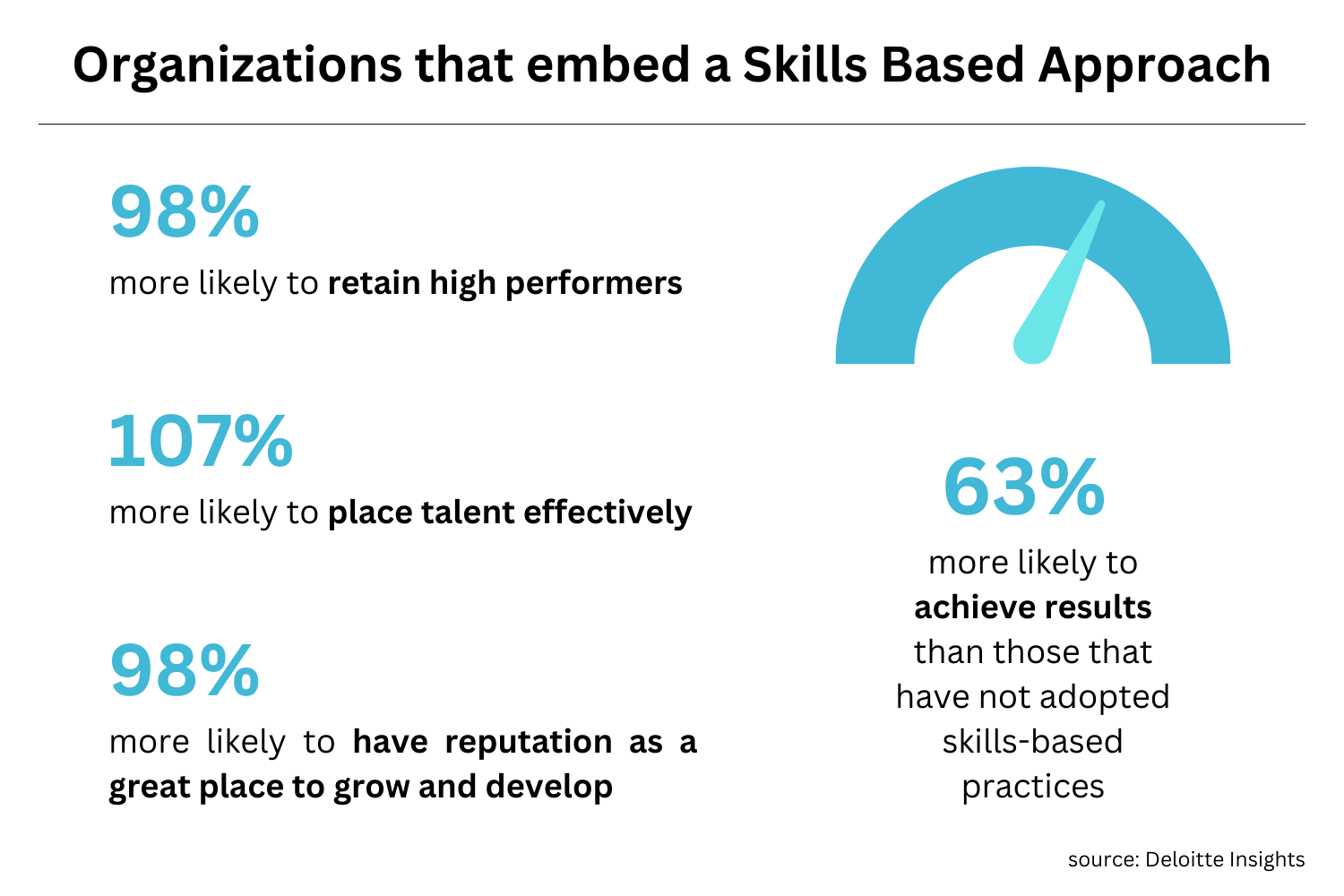
89% of executives say skills are becoming important for the way organizations are defining work, deploying talent, managing careers, and valuing employees.
When the primary goal of a digital transformation is to increase operational efficiencies, a decline in productivity is the last thing you want to occur. If your strategic planning does not account for changes in the skills and capabilities of your workforce, you risk a massive delay in your digital plans.
How can you avoid a problem that sends so many companies to the graveyard of digital transformation?
How Can Organizations Combat the Digital Skills Gap?
You must consider and prioritize employee's skills and capabilities when planning for a digital transformation. To plan effectively, business leaders should first understand the current state of their workforce. You should be able to answer these questions:
What skills and capabilities does your organization currently have?
What are our weaknesses and strengths?
Developing a skills inventory is the best way to visualize and analyze skill levels across your workforce. By developing a clear picture of your current state, you can compare it against your ideal state to determine where you need to grow to ensure a smooth digital transformation.
Related Post: What Are The Business Benefits of Having A Skills Inventory?
Skills inventories provide insightful data that will help you align workforce changes with critical phases of your digital transformation. It will help you identify where you need to retrain, hire, or outsource. You can determine the cost, time, and resources necessary to experience long-term gain from your digital investment.
As business leaders plan for the future, it's not just technical changes they need to consider. Workforces will undergo a massive transformation as well, and if employees are disregarded during strategic planning, organizations can find themselves facing an enormous gap in productivity. How will you ensure your organization is on the side of digital success?
Related Post: How Do You Build A Skills Matrix?
Ready to transform to a skills based organization, but not sure where to begin?
We have automated the steps to make the path easy. Let Visual Workforce help kick start your SBO journey with a free skills framework customized for your company.
Related Posts
The Human Side of Digital Transformation
Digital transformation in any organization is a very big change. But change must happen for any business to survive. The most recent report 2019 Executive Perspectives on Top Risks states boards and C-suite leaders globally are most concerned about their organizations’ ability to transform so they can compete with organizations that are “born digital.”
The Human Side of Digital Transformation
Digital transformation in any organization is a very big change. But change must happen for any business to survive. The most recent report 2019 Executive Perspectives on Top Risks states boards and C-suite leaders globally are most concerned about their organizations’ ability to transform so they can compete with organizations that are “born digital.”
When organizations do embark on a digital transformation only 5% achieve or exceed their own expectations. Why? Because organizations fail to recognize one of the largest contributing factors to the success or failure of a digital transformation, people and their resistance to change.
Why Do People Resist Digital Transformation
The first thought many people have when facing a transformation is uncertainty. They know nothing about this new technology or how to use it. It makes them feel incompetent, that their skills are obsolete and so they resist.
New technology ushers in a new way of doing business. People often lay claim to an area of the business for which they were hired as “experts.” For many, they also tie expertise to self-worth. Suddenly, their area of business is under attack. Loss of control rattles their identity as an expert and so they resist.
Digital transformation is a major technology impact that sends disruptive ripples throughout the entire workforce. People are creatures of habit. Disruptions are not tolerated well. They are found to be distracting and even confusing. People crave the automatic nature of routines. Change is not automatic. It is uncomfortable and so they resist.
How To Successfully Navigate the Human Side of Digital Transformation
To successfully navigate your digital transformation it is imperative you bring your people with you on the journey. To do this you will need an inventory of employee skills and capabilities. You need to understand where you are before you can plan a road forward for your workforce.
A skills inventory is the best way to visualize and analyze skill levels across your workforce. Your skills inventory, at a minimum, answers these two questions:
What skills and capabilities does your organization currently have?
What are your weaknesses and strengths?
Armed with a clear picture of your current state, you can compare it against your ideal state to determine where and how you need to grow to ensure a smooth digital transformation. Identifying existing people you can upskill, where you need new hires, or what workloads are best outsourced. You can also determine the cost, time, and resources necessary to experience long-term gain from your digital investment.
Digital transformation is not just a technology swap but a cultural shift that will cause massive transformations in the workforce as well. Leave your people behind and you instantly build resistance to the transformation then quickly find yourself facing an enormous gap in productivity. Your transformation on the cusp of failure. And your bottom line in tatters.
Change is uncomfortable, but understanding where your people are and showing them the steps to take to move forward eases the way. Strategic planning for your workforce is just as important as selecting new technology for your organization.
How will you ensure your organization is on the side of digital success?
Ready to prioritize the human side of digital transformation? You’re in the right place.
Learn how Visual Workforce helps you automate the discovery and optimization of the skills of your people, teams, and projects to build the foundation for a successful digital transformation.
Subscribe
Sign up to receive updates and announcements from Visual Workforce.
Related Posts
How Can Data Accelerate Change Management?
Change is inevitable, especially in today’s evolving digital economy. The majority, if not all, organizations will undergo a transformation in the coming years. This could be the result of a merger or acquisition, a product expansion, a strategic pivot, or a digital transformation.
We wanted to explore how leveraging data in your change management approach can help combat several challenges business leaders face that contribute to the 70% failure rate. To investigate how data can elevate your approach to change management, we sat down with two experts: Cynthia Siewert and Tammy Marino MBA, Ed.D.
Change is inevitable, especially in today’s evolving digital economy. The majority, if not all, organizations will undergo a transformation in the coming years. This could be the result of a merger or acquisition, a product expansion, a strategic pivot, or a digital transformation.
Regardless of the motivation driving the change, all business leaders will be faced with a similar and vital challenge: managing organizational transformation.
What is often referred to as the “soft-side” of change deals with an organization's most critical component, its people. According to an industry report from McKenzie, nearly “70 percent of change programs fail to achieve their goals, largely due to employee resistance and lack of management support.”
Why Traditional Change Management Approaches Are Falling Short
If 70% of change initiatives fail in large part due to resistance, then our current approach to change management must be flawed. Why are employees so resistant to change? Why can’t business leaders lead employees through the change to reach a successful outcome? What are we missing?
The numbers speak for themselves. While employee resistance is one of the biggest barriers to change, McKenzie also found that 30% of programs are more likely to stick if people are truly invested in the change.
People are the answer. The question is how can we incorporate people into our transformation strategies in an actionable way that drives real results?
Let’s talk data.
Taking a Data-Driven Approach To Change
2.5 quintillion bytes of data are created every day. Business leaders are scrambling to leverage big data in their operations, marketing, IT, and even financial systems. Last year, 83% of executives reported pursuing big data projects to seize a competitive edge. There’s no doubt that data is at the forefront of modern business strategy and innovation.
But, if data is the future, why aren’t more business leaders taking a data-driven approach to change management?
We wanted to explore how leveraging data in your change management approach can help combat several challenges business leaders face that contribute to the 70% failure rate.
To investigate how data can elevate your approach to change management, we sat down with two experts: Cynthia Siewert and Tammy Marino MBA, Ed.D.
Cynthia Siewert is the Head of Product Management and Customer Success at Visual Workforce. She has spent more than 10 years focused on driving change in large organizations in various industries such as Financial Services, Healthcare, and Transportation. Driven by a passion for building relationships at all levels of the organization, she has a track record of blending the strategic and the tactical to make change stick.
Tammy Marino is a Principal Consultant and founder of APS Team Solutions. Her passion for developing leaders has been evident in her work with over 5000 individuals and organizations. Through relationship-based coaching and consulting, she utilizes research and best practices to ensure client success. With many years of experience delivering performance management coaching and consulting, she brings a high level of professionalism to the services of APS Team Solutions.
Table of Contents
Below are the full details from the interview. Here’s a quick look at what we’ll cover:
1 | Use Data to Baseline and Define The Change Roadmap
The first step of any change management strategy should be to define your organization’s current state. Our experts recommend taking a “baseline” of your employees’ current capabilities to quantify key information that will build the foundation for your transformation plan.
Cynthia: “There are several ways that I incorporated data into my organizational change management consulting practices. And the first was always to baseline because... you’re able to get a clearer picture of where you’re going and how much effort it's going to take to get there if you know where you are now.”
Tammy: “Yes, I think a baseline is critically important. One of the things we find when we gather data for a baseline is that the data is often different than what the principal person or change champion thinks [the current state] is or should be. So, not only is the baseline important for what Cynthia stated, but it also helps quantify what the organization thinks is happening.”
Tammy: “For us, that’s the first step for change. Managers will say ‘we thought that turnover was really not that bad’ but the baseline shows it’s like three times more than they thought it was.”
Taking the time to conduct a baseline can also help you define the problem and develop a measurable roadmap for change.
Cynthia: “We want to see where we’re starting and then see the growth and milestones from there. [A baseline] helps define the problem, too. If you can’t quantify [the problem], then it becomes this nebulous thing that’s really hard to get to… you never know when you’re done.”
Tammy: “And that’s very subjective, right? I mean, when I’m done might be different than when you’re done. So [data] also makes it much easier to say we’ve reached [the goal] or this is what needs to be changed.”
Oftentimes, organizations want to dive into every change initiative at once to hurry up and avoid resistance. However, this tends to lead to greater pushback. Instead of choosing every initiative to pursue, baseline data can help you prioritize and select the change programs that are most likely to succeed with your teams’ current skills and capabilities.
Tammy: “I had some organizations that we’ve worked with in the past, that say ‘we don’t want to roll out Change X, until we have A, B, C, and D all done. We want to roll out all the change at once because our people tell us that they’re really resistant to change and don’t like it.’”
Cynthia: “I have seen it done, for example, where an organization wants to replace a huge ERP or do some system migration, where executives have three technology options in front of them. If you can look at your organization and say ‘I know I have the skills in-house that best match the solution’ then you’re able to choose a change.
You should decide which of those changes you are going to implement based on what you have the best chance for success [with] and you won’t have a big gap to overcome. So again, that’s the baseline -- knowing where you are today allows you to choose the right changes to make.”
2 | Use Data To Create A Culture of Trust and Learning
While managing people can involve factors that are hard to measure, like trust, data can help you build credibility and internal support for your change initiatives.
Cynthia: “Data provides these objective measures if you will. It lends credibility to what it is you’re doing and a key component to managing change in an organization is the trust of the people in those leading the change. Objectivity tends to increase this level of trust that people have rather than the change being an opinion or a new flavor of the month.”
Cynthia: “The other place that data could be useful is in convincing executive leadership or a board to take the leap to make the change. When you show them the data on skills in the organization that are not being utilized to their best ability or could make this transition easier, that eliminates some of the resistance at the executive level.”
Another factor that’s hard to quantify is fear. However, this factor can be paralyzing. Tammy explains how data can be used to eliminate fear and drive a learning culture that supports change.
Tammy: “We can learn in the discomfort zone, but we shut down and stop learning in the fear zone. I feel like Visual Workforce does a really great job of illustrating, for managers in particular but also employees, like wow okay, that’s an eight-point jump for this person. That’s going to propel them straight into the fear zone and they’re going to shut down and not want to learn or be able to learn. But for these other two people on my team, it's just a small stretch. We’ll start there and get them up and running then move on to the other person with the bigger leap.”
3 | Use Data to Measure Progress and Build Support
The advantage of data doesn’t start and stop at the baseline. As your transformation roadmap progresses, data enables managers to quantify progress and quickly make credible changes to their plan.
Tammy: “As you move through the change initiative, it’s really powerful and empowering to be able to measure what that looks like. Are we achieving our goals? Let’s hit pause and identify where the challenges are and reroute some of our strategies to address those challenges.”
Cynthia: “It’s amazing to me how many organizations don’t even measure what they think they measure.”
Tammy: “Yes, they’ll move along thinking that they’re making progress because people they interact with on a regular basis are indicating that progress is being made. But, across a wide change management initiative, we may not have those interactions with everybody in a timely manner.
So I think employing a tool like Visual Workforce enables managers to say ‘Hold up, we thought everyone would be at this level by now and they’re not. Let’s take a look and see where we can adapt and adjust.’ This makes organizations much more agile in that change management process.”
4 | Use Data To Identify and Develop Key Skills Essential for Change
The popular change management model, ADKAR stands for Awareness, Desire, Knowledge, Ability, and Reinforcement. The second “A” or “Ability” represents the need for people to demonstrate the skills and behaviors necessary to implement the change. This stage often becomes an unanticipated challenge for many leaders.
Collecting real-time skills data can help you identify skill gaps and proactively develop new strategies, training programs, and resources to combat this potential roadblock.
Cynthia: “[People] can know how to change but if they don’t have the skills necessary to do it, they will be unsuccessful. That’s where data around the staff you have can really come in handy and provide people with the ability to develop the skills that they need to implement the change.”
Cynthia: “That’s one of the key reasons that organizational changes don’t actually manifest. People in the organization don’t have the ability to move.”
Tammy: “Then all sorts of roadblocks, speedbumps, and brick walls are built up. It’s a defense mechanism. When you don’t know how to do something then it must be stupid or doesn’t have value and people will resist.”
Cynthia: “Exactly. I think of the power in having skills data here. Let’s say you’re a line manager and you know the change is coming and you know people are really nervous about it. But, you’re able to sit down, one-to-one, and say ‘I know you have these skills today. I know these are the skills you’re going to need tomorrow and we have to plan to get you there.’ There, again, build trust and it starts to mitigate some of the resistance.”
Capturing and measuring skills data also allows managers to compare progress across various teams. If one team is successfully implementing the change and another is struggling, a manager can use skills data to evaluate the potential cause and take action.
Cynthia: “Having a broad set of skills data allows you to figure out what it is that’s allowing one team to be more successful than the other. I think having that information at your fingertips can actually help you use the insights to then improve your weaker teams and get them to the same place as your successful team.”
5 | Use Data To Build Resilience Instead of Just Reducing Resistance
A fundamental pillar of change management is mitigating resistance to change. However, using data, our experts discuss a different approach that focuses on proactively building resilience amongst employees.
Cynthia: “You’re already assuming you’re mitigating resistance. You’re already assuming resistance is going to happen. Really, what you are doing is responding to it in a lot of ways. What if we backed up a little bit and instead of focusing on managing resistance, we started building resilience to change in the organization before the change begins?
Instead of investing all your time into resisting change, you can invest your time in supporting and creating it. Change is constant. Give people the tools upfront to be able to build resilience to changes.
I think those tools are things like trust, emotional intelligence, knowing you have managerial support. Even individually, having access to data on what skills you have and what skills you are developing. Really identify and understand where a team is as a whole before you dive into the change management stuff. You won’t have as much resistance to mitigate if people are ready for the change.”
As companies dive into the digital age, those that can adapt and leverage new capabilities will ultimately win. This starts by employing a data-driven change management strategy that empowers managers and employees to develop new skills, create a culture of learning, and ultimately drive the transformation efforts from within. How will you leverage data to elevate your approach to change management?
About APS Team Solutions
APS Team Solutions has supported over 5000 small business leaders with performance management practices. They offer relationship-based consulting and coaching to entrepreneurs, small business owners, and new or aspiring managers to assess issues, create a plan, and implement strategies. APS Team Solutions offers research-based materials and consultation that empower leaders to confidently lead their teams.
About Visual Workforce
Visual Workforce is a revolutionary SaaS solution that allows companies to make more informed business decisions to achieve corporate initiatives faster, easier, and less expensively than they have in the past. We automate the capture of critical skills and capabilities data of individuals, groups, departments, or entire companies to provide business analytics for data driven decisions. Through powerful, easy to interpret visualization tools, Visual Workforce identifies skill gaps in both current and future states and provides a path to close those gaps.
Related Posts
How to Avoid A Skills Gap in a Growing Venture
The skills gap is growing problem facing numerous industries. No company, big or small, is exempt from a potential skills shortage, particularly in technical skills. According to a recent study, 60% of U.S. employers have job openings that stay vacant for 12 weeks or longer. On average these vacancies are costing businesses up to $800,000 annually.
However, the implications of a skills gap takes on a different, often more intense meaning for a growing venture than an established corporation.
Updated on March 2, 2025: Added new information and updated statistics with recent developments on the skills gap.
Skills gaps have evolved from a localized concern to a critical global challenge, acting as a significant impediment to business growth and innovation. The World Economic Forum's (WEF) 2025 Future of Jobs Report powerfully illustrates this, asserting that the inability to meet rapidly evolving skills demands is not merely slowing progress, but fundamentally reshaping industries and creating unprecedented pressures for both workers and employers. This isn't just about technical skills; it's about the broader spectrum of competencies needed for the future of work. Lightcast's analysis further emphasizes this, revealing the persistent and widening mismatch between employer needs and the skills readily available in the workforce.
The focus is shifting to 'power skills' or human skills, such as critical thinking, problem-solving, creativity, and emotional intelligence, which are increasingly valued alongside technical proficiency. This skills deficit is not only leading to prolonged vacancy durations, but also impacting productivity, innovation, and overall competitiveness. The ripple effects of these skills gaps are profound: they contribute to wage stagnation for some, while driving up costs for employers seeking specialized talent. They exacerbate inequalities, as those without access to reskilling and upskilling opportunities are left behind. In essence, the skills gap is not just a talent shortage; it's a structural challenge that demands a collaborative effort from governments, educational institutions, and businesses to invest in continuous learning, promote lifelong employability, and foster a culture of adaptability.
However, the implications of a skills gap takes on a different, often more intense meaning for a growing venture than an established corporation. Startups operate in a high-growth environment. Decisions come with high stakes, yet founders don’t have the same luxury of time or resources as a corporation. It’s no surprise then that 90% of startups fail.
If your venture has gained traction and found its product-market fit, congratulations! Now you're ready to take the leap to the next stage, growth. For a startup to continue to succeed it must scale with the demands of the market. While market demand will drive sales, rapid growth doesn’t happen by accident. Scaling your company requires deliberate planning and preparation to keep up your growing demand once you open the floodgates.
Unfortunately, many startups dive into the growth stage without a well thought-out scaling strategy. According to the Startup Genome Project, “premature scaling is the most common reason for startups to perform worse. They tend to lose the battle early on by getting ahead of themselves.”
Your Company is Evolving… So Should Your Team
While there are many components to developing a growth strategy that gets results, we find one of the most important components is your team. To scale hard and fast, a founder must have the right capabilities and skills on his or her team to make the tough transition.
These skills and capabilities often look very different from the initial requirements of an early-stage startup where the goal is to develop, test, and generate traction for the initial product or service. In the growth stage, your team needs to systematize operations, aggressively raise capital, and develop a scalable sales and marketing strategy.
Do you see why each stage requires a different set of skills? If a founder is not aware of this difference, a skills gap can start to form and threaten growth potential.
Related Post: How Skills Planning Can Help Your Company Achieve 6 Types of Transformations
Startups Must Prioritize Talent Management to Scale and Succeed
While it’s important for all companies to develop and execute a talent management strategy, growth-stage startups should look to align their team’s skills and capabilities with their growth strategy.
Why is it so important for startups to prioritize talent management and skills planning?
First, the small-team nature of a startup means employee performance is highly connected. Unlike a corporate environment, one employee can have a significant effect on the outcome of the startup. A bad hire, whether poor skills or cultural fit can easily drag down the performance of your whole team. Likewise, a good hire can complement or even enhance others’ capabilities, driving better performance from the whole team.
Second, cash reserves are limited. Founders must have a core strategy for selecting and managing talent because there is little wiggle room for mistakes. Corporations have big budgets to invest in advanced systems, formal training programs, and an army of managers. Startups likely do not have extensive resources or need to allocate funding to other areas of the business. However, limited resources isn’t an excuse to ignore your talent strategy. In fact, it means you should invest meaningful time to ensure you are getting the right people from the start and developing your team as your startup grows.
Third, all startup jobs require unique flexibility from employees. Small teams and a fast-paced environment often require employees to wear multiple hats, especially on the leadership team. A founder might take the formal role of CEO but also execute financial tasks typically managed by a CFO. Likewise, a back-end architect may also need to do some front-end work on the application. Flexibility is a must in the startup job world. Your talent management strategy can help you find and retain talented individuals whose hard and soft skills are uniquely suited for the rapidly changing startup environment.
Fourth, when startups hit their growth stage, you must recruit leaders who can bring organization and expertise to the chaos. At this point, founders need to prioritize leadership. Selecting and keeping the right leaders can be challenging if you are not actively aware of what your current team’s strengths and weaknesses. A talent management strategy can help guide you.
How to Plan Your Talent Management Strategy and Avoid a Skills Gap
Incredibly, 50% of all emerging companies do not have a formal talent strategy. As a founder, the most important step you can take to prevent a skills gap is to plan, plan, plan. When it comes time for your company to grow, the last thing you want is to do is put out fires that could have been prevented by simply planning ahead.
To help get you started, here are some actionable steps you can take today to anticipate and plan for your team’s skill needs when you reach the growth stage:
1 | Outline the skills you have and the skills you will need
To understand where you need to go, you must first know where you are. The same goes for your team’s skills and capabilities. First, identify your team’s existing roles and skill requirements. Now ask yourself, what additional roles and skills will my growth strategy require?
2 | Develop a skills inventory to track your team’s skills and growth
Now that you’ve outlined the skills requirements, it's time to develop a system for tracking and managing your team’s skills. You want to invest in skill management software that allows you to track current skills to compare against your requirements. We recommend using a tool called a skills inventory.
Related Post: The Best Way To Identify and Track Your Team’s Hard and Soft Skills
What is a skills inventory? It’s a tool that allows you to identify the current skills and capabilities of your workforce. It helps you recognize skill gaps and provides a clear vision for how your workforce needs to change or grow.
A good skills inventory leverages data visualizations to quickly and accurately draw insights from your skills inventory. Take a look at the skills inventory example below:
In this skills inventory example, the bar chart allows you to compare where your team is now against your skills requirements for growth. As a founder, you don’t always have the luxury of time. Data visualization allows you to make data-driven decisions in a timely manner.
Related Post: 4 Ways Data Visualization Can Improve Your Decision Making
3 | Take action and focus on employee growth
Once you set up your skills inventory and have identified opportunities for growth, put those insights into action. How will you help your team reach the skills and capabilities necessary to make the transition to the growth stage and scale successfully? Do you need to recruit for the right skills or can you train your existing talent? There’s always an argument for both, but a strong emphasis on employee growth can help you develop a stronger culture, retain top talent, and use your resources wisely.
Related Post: Why Your Employees Want You To Focus on Career Growth, Not Just Engagement
Ready to invest in the future of your workforce?
Learn how Visual Workforce can help you discover and optimize the skills and capabilities of your people, teams, and projects.
Subscribe
Sign up to receive updates and announcements from Visual Workforce.