
Why The Skills Gap Is Still Growing

Updated on March 9, 2026: Added new information and updated statistics with recent developments on the skills gap and how companies are adapting to deliver people and business outcomes.
Why the Skills Gap Is Still Growing in 2026
In boardrooms, conference calls, and the quiet corners of offices late in the evening, a familiar concern has settled into the background of business life. Ask a room of executives what keeps them awake at night and the answers tend to circle back to a surprisingly simple problem: finding people with the right skills to do the work that needs to be done.
The modern workplace is evolving with remarkable speed. Software tools appear and disappear in rapid cycles, automation is rewriting how routine work gets completed, and artificial intelligence is steadily changing the nature of tasks that once required years of training. Entire professions are shifting under the weight of these changes. The workforce itself, however, moves at a more human pace. Skills take time to develop, experience accumulates gradually, and careers unfold across decades rather than quarterly earnings reports. The result of this mismatch is what economists have come to call the skills gap, a problem that has been discussed for years and yet continues to widen in 2026.
Recent data helps illustrate the scope of the issue. Seventy eight percent of business leaders say building workforce capabilities is essential to long term growth. Nearly half of workers report learning new technology simply to keep up with the demands of their current jobs, while more than half believe their professional skills will need to change again within the next five years. Eighty seven percent of companies say they already face skill shortages or expect them soon. Three quarters of employers report difficulty finding qualified candidates, and sixty percent say open roles remain unfilled for three months or longer. The cumulative impact of these trends is enormous. Analysts estimate the global skills gap could cost businesses as much as 8.5 trillion dollars in lost revenue by 2030, a number large enough to command attention in any boardroom.
Demographic trends suggest the challenge will intensify before it improves. A recent labor analysis from Lightcast indicates the United States could face the largest worker shortage in its history. Baby Boomers are retiring in large numbers, birth rates have declined for decades, and labor force participation remains historically low. Together these forces could produce a deficit of six million workers by 2032. Healthcare systems, hospitality organizations, and service industries are expected to feel the pressure first, though the effects will ripple across nearly every sector of the economy. Businesses will increasingly need to accomplish more with the workforce they already have.
See How Companies Are Responding
Many organizations are no longer treating the skills gap as a hiring problem alone. Instead, they are beginning to map the skills already inside their workforce so leaders can identify gaps, deploy talent more effectively, and plan for future workforce needs.
Visual Workforce allows organizations to see the skills across their people, teams, and projects in real time.
Schedule a quick 15 minute demo to see how workforce leaders are using Visual Workforce to uncover hidden talent and identify skill gaps across their organization.
Why This Matters Inside Your Company
Conversations about the skills gap often appear in economic reports and policy discussions, which can make the issue feel distant or theoretical. Inside companies, however, the impact is much more immediate. Projects move more slowly than planned when teams lack key expertise. Managers spend weeks searching for candidates who can fill critical roles. Job postings remain open for months while workloads quietly expand for the employees who remain.
Extended vacancies also carry a significant financial cost. Large organizations can lose hundreds of thousands of dollars each year simply because positions remain unfilled. More than two thirds of employers report that skill shortages are already reducing productivity, and when productivity declines the effects spread quickly across budgets, timelines, and customer expectations. What begins as a hiring challenge often grows into a broader operational problem.
At that point the conversation inside leadership teams changes. The question is no longer whether the skills gap exists. Most leaders already recognize the challenge. The more pressing question becomes how organizations can identify skill gaps earlier and respond before those gaps begin to disrupt projects or slow growth.
Discover the Skills Inside Your Workforce
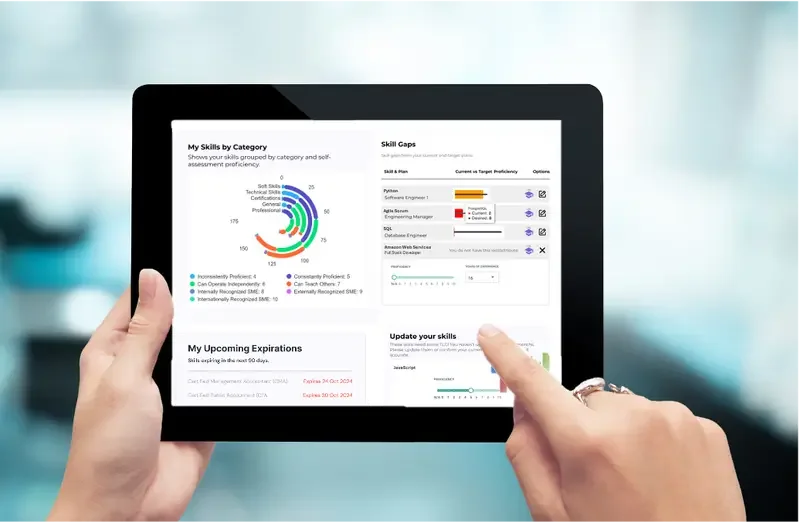
Many organizations already have more talent than they realize. The challenge is seeing where those capabilities exist and how they can be applied across projects.
Visual Workforce provides a real time map of workforce skills so leaders can identify gaps and deploy talent with confidence.
See how it works.
Request a 15 minute demo today.
The Problem Many Companies Cannot See
A subtle twist often appears in conversations about workforce shortages. Companies frequently believe they are facing a simple lack of talent, when in reality a different issue is often hiding beneath the surface. The challenge is not always a shortage of capability. In many cases it is a lack of visibility into the skills already inside the organization.
Employee skills are rarely stored in a single place. A resume may sit inside an HR system, performance reviews live in another database, and a spreadsheet created years ago might attempt to track certain certifications or technical abilities. Managers often know the capabilities of their own teams, though that knowledge rarely travels far across departments. Over time employees develop new skills, gain experience with different tools, and acquire expertise that never gets recorded anywhere central. Within months the available data becomes outdated.
Leadership teams then find themselves unable to answer surprisingly basic questions. What skills actually exist across the organization today? Where are the most significant gaps? Which employees might be able to step into new roles if given the opportunity? Without clear answers, companies begin to rely on guesswork. Hiring decisions become reactive, internal mobility remains limited, and projects may stall simply because the right expertise cannot be identified quickly enough.
Move Beyond Spreadsheets
Tracking workforce skills in spreadsheets quickly becomes outdated as teams grow and technology evolves.
Visual Workforce replaces manual tracking with a dynamic view of workforce capabilities, helping organizations identify skill gaps across people, teams, and projects.
Explore how the platform works in a 15 minute demo.
Why the Gap Keeps Growing
Several powerful forces continue to widen the skills gap across industries. Technology evolves rapidly, often faster than workers can adapt. Digital transformation has spread far beyond traditional technology companies, influencing sectors such as healthcare, manufacturing, finance, and logistics. Hospitals rely on complex data systems, supply chains depend on advanced analytics, and manufacturers operate increasingly sophisticated automation platforms. Each of these shifts requires new technical skills that did not exist in many workplaces just a decade ago.
Learning those skills takes time. Nearly one in five workers says their professional abilities are already outdated. The demand for technical expertise has expanded into industries that historically did not require it. Government data shows that more than two thirds of technology related roles now exist outside traditional tech companies, appearing instead in sectors such as transportation, healthcare, finance, and manufacturing.
Education systems are working to close this gap, though progress remains uneven. Surveys show that nine out of ten parents want their children to study computer science, yet only about one quarter of schools currently offer programming courses. Students entering the workforce often encounter technologies and systems that did not exist when their curriculum was designed.
Companies face an additional challenge in how they respond to these skill shortages. Many organizations attempt to solve the problem through external hiring rather than internal development. Technical talent, however, remains scarce. Hiring cycles grow longer, open roles remain vacant, and organizations overlook the possibility that existing employees could grow into those positions with the right support.
Strategic planning can also be limited. Numerous companies still rely on informal conversations between managers or outdated spreadsheets to track workforce skills. These systems rarely remain accurate for long.
See Workforce Skills Clearly
Organizations that gain visibility into their workforce capabilities can make smarter decisions about hiring, training, and project staffing.
Visual Workforce helps leaders map workforce skills and identify gaps across the organization in real time.
Schedule a 15 minute demo to see how the platform works.
What Companies Are Beginning to Do Differently
A growing number of organizations are approaching workforce challenges from a different perspective. Instead of guessing about employee capabilities, they are investing in structured skills planning, a process built on a simple principle: effective management requires visibility.
The process begins by mapping the skills currently inside the workforce. Leaders then compare those capabilities with the skills required for upcoming projects, new technologies, and long term business goals. Once that comparison becomes clear, companies can identify gaps early and respond through targeted hiring, internal mobility, or training programs designed to strengthen existing teams.
For many years organizations attempted to manage this information through spreadsheets or occasional employee surveys. Those tools quickly become outdated as teams evolve and skills change. Modern workforce intelligence platforms offer a more dynamic approach, continuously mapping employee capabilities, tracking proficiency levels, and revealing emerging gaps across departments.
This shift allows leaders to move from reactive hiring toward proactive workforce planning.
The Bottom Line
The skills gap is unlikely to disappear in the near future. Technology will continue to advance, workforce demographics will continue to shift, and organizations will continue searching for people who can keep pace with those changes. Many companies, however, are beginning to recognize that the deeper challenge is not always a shortage of talent.
The more fundamental problem is often the inability to see the talent that already exists.
Companies that gain visibility into workforce skills can close gaps more quickly, reduce hiring costs, and deploy their people more effectively across teams and projects. Organizations that lack that visibility frequently find themselves reacting to problems that could have been predicted months earlier.
See How Visual Workforce Helps
Visual Workforce gives organizations a clear picture of the skills across their workforce so leaders can identify gaps, optimize talent, and plan for future workforce needs.
Schedule a 15 minute demo today and see how Visual Workforce can help your organization uncover the skills already inside your teams.