
Bring role clarity, shared priorities, and visible progress into the conversations that help teams move forward.
Performance is a habit, not an event.
But keeping that habit aligned gets harder as an organization grows. A first review needs a different structure from an annual evaluation. Managers need context between formal reviews. Employees need to understand what matters now and what success looks like. HR needs a clear view without coordinating every conversation.
Visual Workforce Performance Management brings reviews, check-ins, and goals into the same platform as your skills intelligence and workforce planning. A consistent framework gives people a shared starting point, while flexible review formats keep the conversation relevant.
Our first post explored why completing reviews is not the same as managing performance. Here is what supports the process in practice.
Tailor the conversation to the role, not the paperwork.
A useful review helps people understand what drives success in their role. It should not begin with translating a generic form into something relevant.
Visual Workforce supports configurable review templates, sections, and questions. Organizations can use weighted or unweighted questions, define weighted goal categories, and include appropriate goal and role context.
Five-point, behaviorally anchored rating questions give people descriptions to work from rather than a number alone. Employee and manager responses provide space to discuss achievements, clarify expectations, and consider different perspectives.
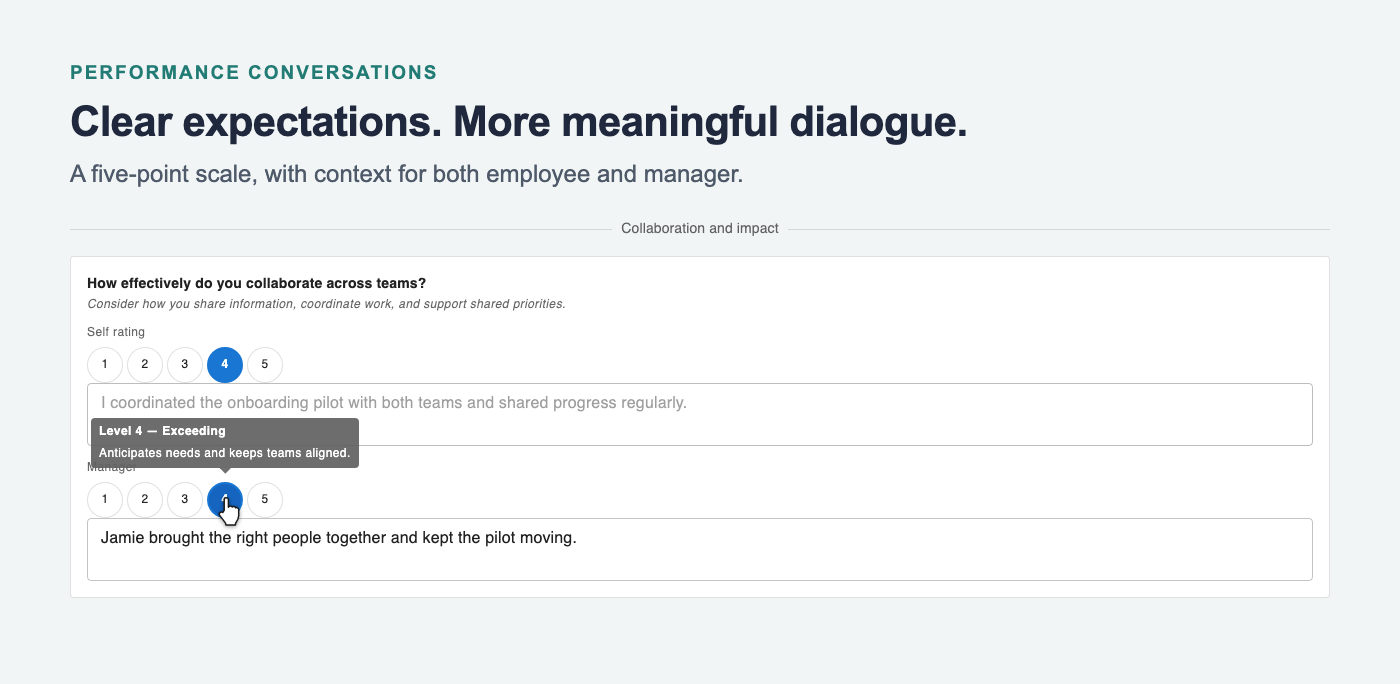
Clear expectations give the conversation a useful starting point.
With relevant questions and clear rating descriptions, the form becomes a starting point for useful dialogue about the role and its priorities.
Keep momentum between formal reviews.
A monthly check-in should not have to become a smaller copy of the annual appraisal.
Visual Workforce separates check-in and performance-review programs, with independent settings for supported cadences. Those cadences include annual, semiannual, quarterly, monthly, 90-day, and ad hoc reviews.
That gives teams a framework for lightweight conversations between formal evaluations. A check-in can capture recent wins, surface obstacles, and clarify the next priority while there is still time to respond. A formal review can bring a broader period into view.
Documenting progress along the way gives employees and managers context to revisit, rather than relying only on what they remember at year-end.
Consistency does not require every conversation to use the same form.
Give new team members a clear start.
The first months in a role are an opportunity to establish direction, recognize early wins, and address questions before they become entrenched.
When enabled and configured with an appropriate published template, automated 90-day enrollment creates the review ahead of the milestone. Configured reminders and overdue escalations help keep assigned reviews moving.
That creates a timely starting point for discussing expectations, early contributions, and the support a new team member needs. HR does not have to rely entirely on separate milestone calendars to initiate that conversation.
Turn goals into conversations about shared outcomes.
A list of goals becomes more useful when employees and managers can discuss what moved forward and why it matters to the team.
Individual performance goals can include a description, target date, milestone, and dated progress notes. Approval and revision workflows give employees and managers a structured way to clarify priorities and refine commitments as circumstances change.
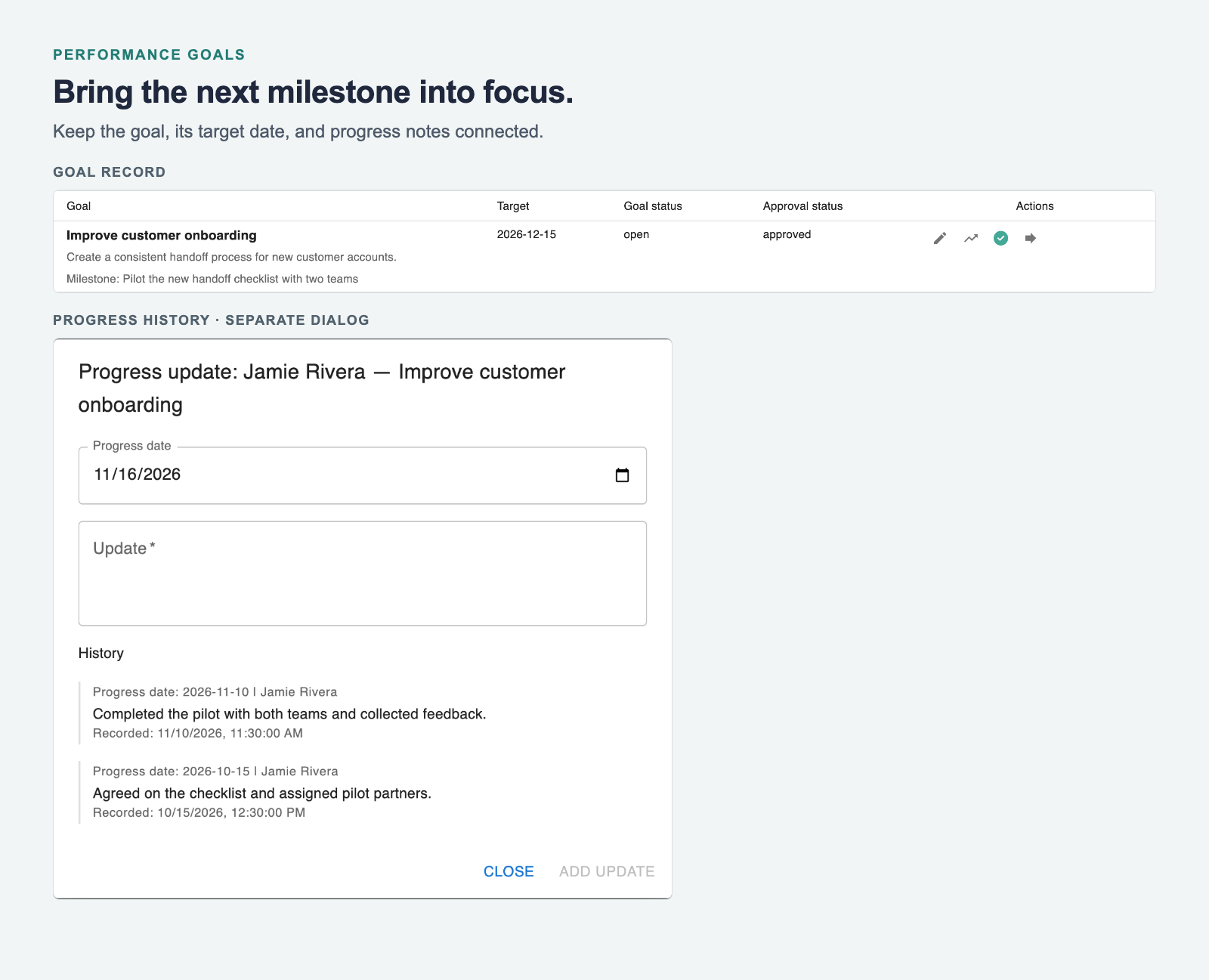
Bring achievements, context, and the next milestone into focus.
Goals can also be added during a review for the current or next performance period. Configured review templates can bring performance goals, skill goals, and current-role plan context into the evaluation.
Those records make specific achievements easier to recognize and give people context for discussing their contribution to business priorities. The next conversation can focus on what matters: celebrate progress, explore an obstacle, or agree on the next milestone.
Give HR clarity without the status-chasing.
HR can support people leaders more effectively when the relevant signals are visible without building another manual status report.
Review operations provides visibility into assigned records, employee and manager input, overdue work, and outstanding signatures. Manager filters help narrow the view. Goal reporting highlights open and completed commitments, overdue goals, pending approvals, and revision requests.
Progress-freshness indicators also identify goals with no updates or updates older than the selected threshold.
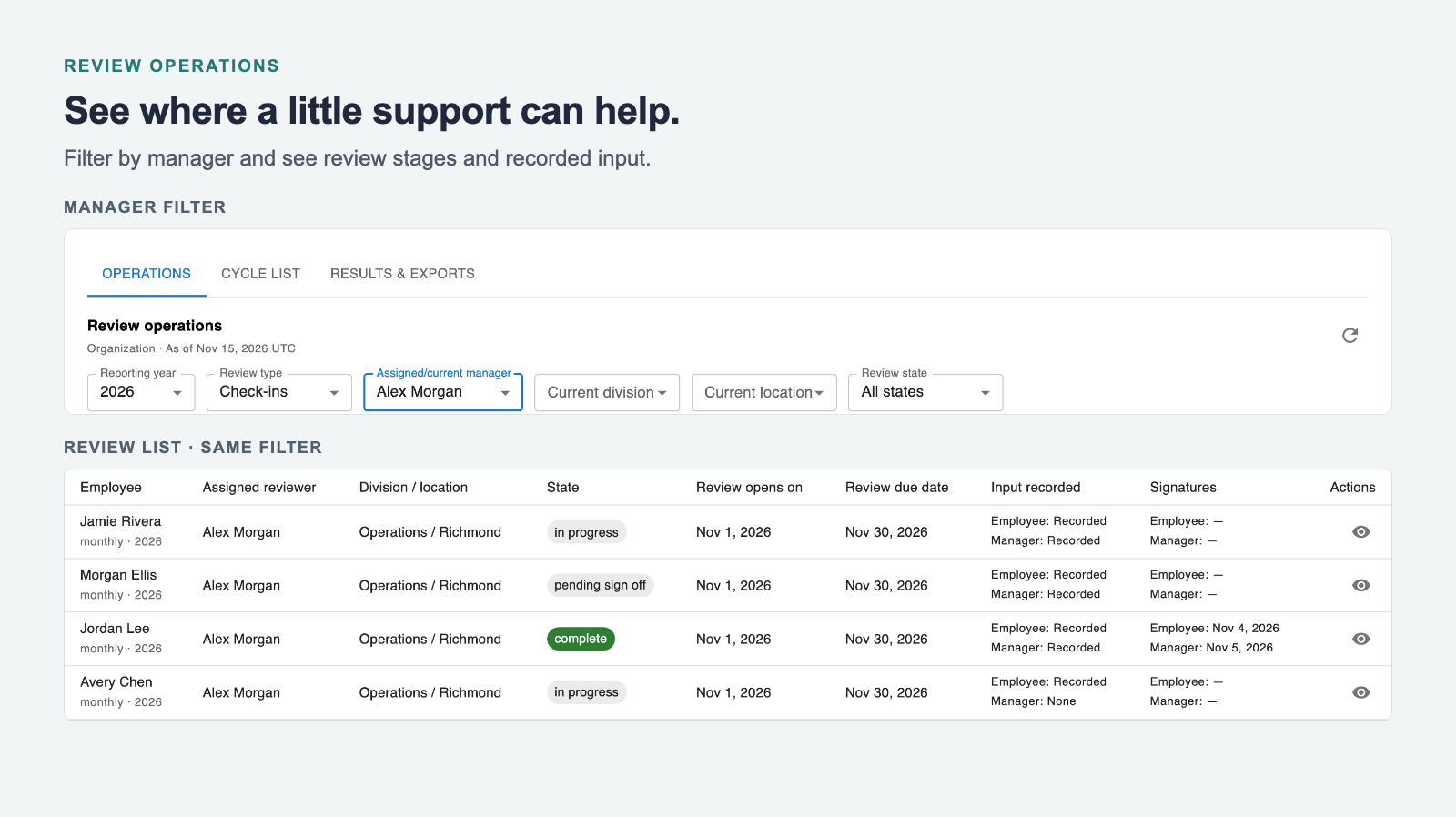
See where the process stands—and where support may help.
The purpose is to help, not to police. An overdue goal may need a dependency resolved; an approval may be holding up the next step; an older progress note may need fresh context.
These signals help HR focus support where it may be useful. They show recorded activity and commitments, not a verdict on whether a team is thriving.
Close the review with clarity.
Structured review states and employee and manager digital sign-off make the closing steps visible. Recorded review actions support traceability.
Microsoft Entra ID and Okta single sign-on, together with role-based access, support a process in which sensitive performance information is available to authorized users.
A clear record of participation and completion lets people see where the review stands, with less ambiguity about the next step.
Keep your HRIS. Keep your history.
Modernizing performance management does not require replacing the systems that handle core employee records and payroll.
Visual Workforce supports more than 200 HRIS integrations, with supported employee data varying by connector. The flow is one-way: your HRIS supplies data to Visual Workforce. Visual Workforce does not push data back to your HRIS.
Onboarding data migration is a separate capability. It can bring prior-year and current-year performance history into Visual Workforce, preserving context as your organization adopts the new process.
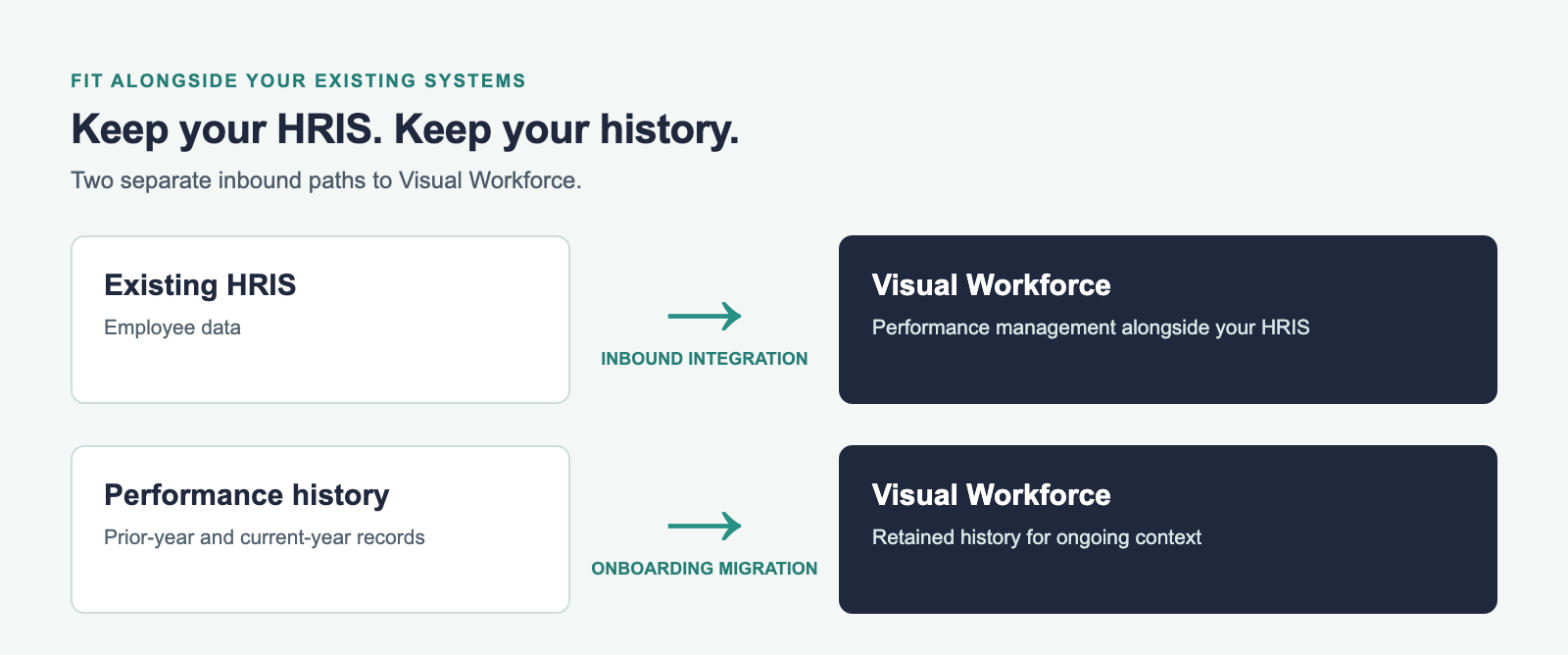
Your HRIS remains the authoritative source for core employee records. Visual Workforce provides the performance-management experience alongside it.
See how the process supports your team's momentum.
Bring a real example to your evaluation: a new-hire review, a monthly check-in, an annual template, or a goal that needs manager approval.
Walk through how an employee understands expectations, how a manager recognizes progress, and how HR identifies where support is needed. Evaluate whether the workflow helps your team spend less effort reconstructing context and more time discussing what comes next.
Your process. A clearer rhythm. Progress in focus.
Schedule a personalized live demonstration via Zoom or Microsoft Teams. Bring your review cadence, template, HRIS requirements, and performance-history needs. Schedule your personalized demo →