
How growing organizations can move beyond review administration to clearer expectations, better conversations, and stronger accountability.
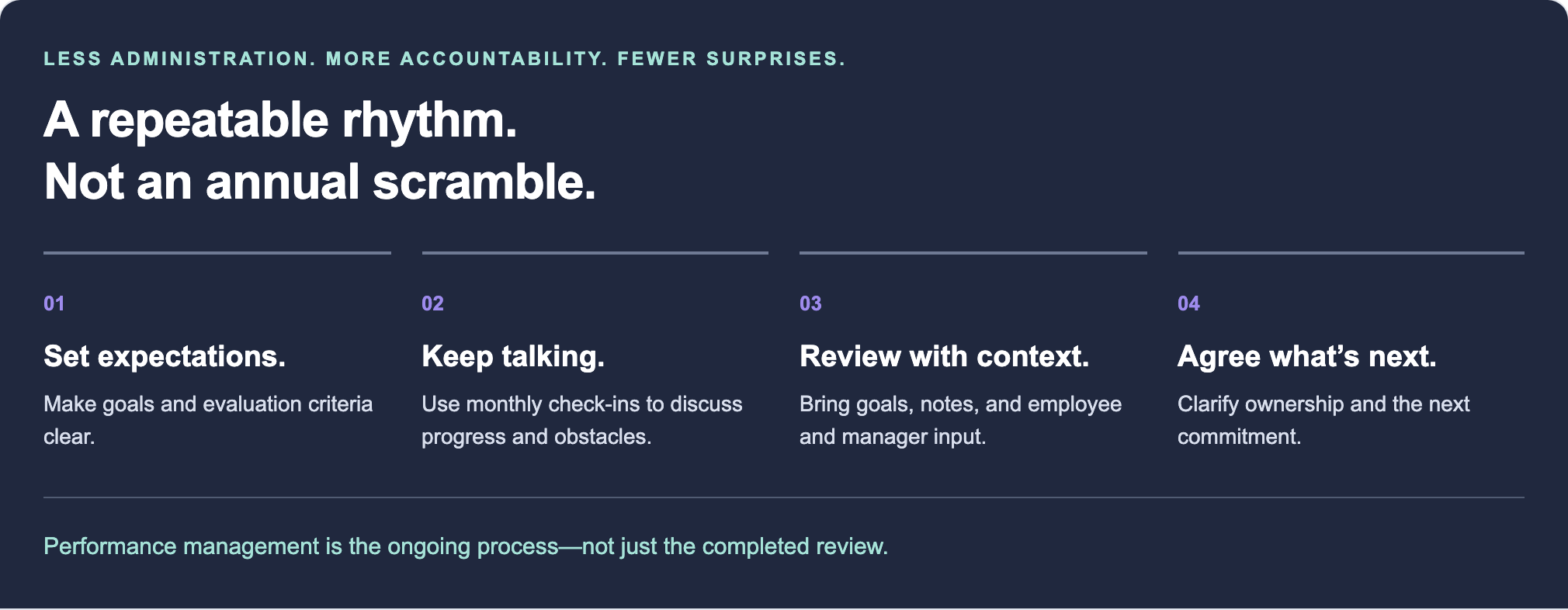
Your performance review cycle is complete. The forms are submitted, the ratings are recorded, and HR has closed the process.
But does your leadership team have the evidence to ask—and act on—three important questions?
What progress are employees and managers reporting against their goals?
Which commitments need attention?
Where is manager input recorded—and where does HR need to follow up?
Completing reviews and managing performance are not the same thing. Growing organizations need a clearer view of progress and participation—not another status-consolidation project.
When the process becomes the work
HR maintains the calendar. Managers search for the right template. Employees reconstruct months of accomplishments. Goals sit in spreadsheets, while review forms live somewhere else. Someone consolidates the results before leadership can see what happened.
The process becomes the work. Visual Workforce adds a modern performance-management layer alongside your existing HRIS: a place for check-ins, reviews, and visible commitments—not a replacement for core HR or payroll operations.
One consistent rhythm—from first review to annual evaluation
A 90-day post-hire review and an annual evaluation serve different purposes. Monthly check-ins keep the conversation moving between them. The process should support those differences without forcing HR to start over each time.
Visual Workforce supports configurable templates, a five-point rating scale, weighted or unweighted questions, and multiple review cadences. Automated 90-day review enrollment, configured reminders, and overdue escalations help keep assigned reviews moving.
What moved forward?
What got in the way?
What needs to happen next?
Employee and manager responses give those conversations a documented starting point. HR can filter assigned check-ins by manager and see recorded input, overdue records, and outstanding signatures. A form does not establish conversation quality; it makes participation and follow-up more visible.
Turn delivery gaps into a focused management agenda
Goal status, dated progress notes, and milestones bring context to a review. Leadership views highlight overdue goals, pending approvals, and revision requests. Review operations also identifies goals with no updates or progress older than the selected freshness threshold.
These signals help managers decide where to look—not how to rate a person. A missing update may need a conversation; an overdue goal may need a dependency resolved or a revised next step.
Consider the illustration below. September has more goals due than completed; October has more completions than goals due that month. That is a prompt to investigate workload and timing, not proof of recovery or employee effectiveness.
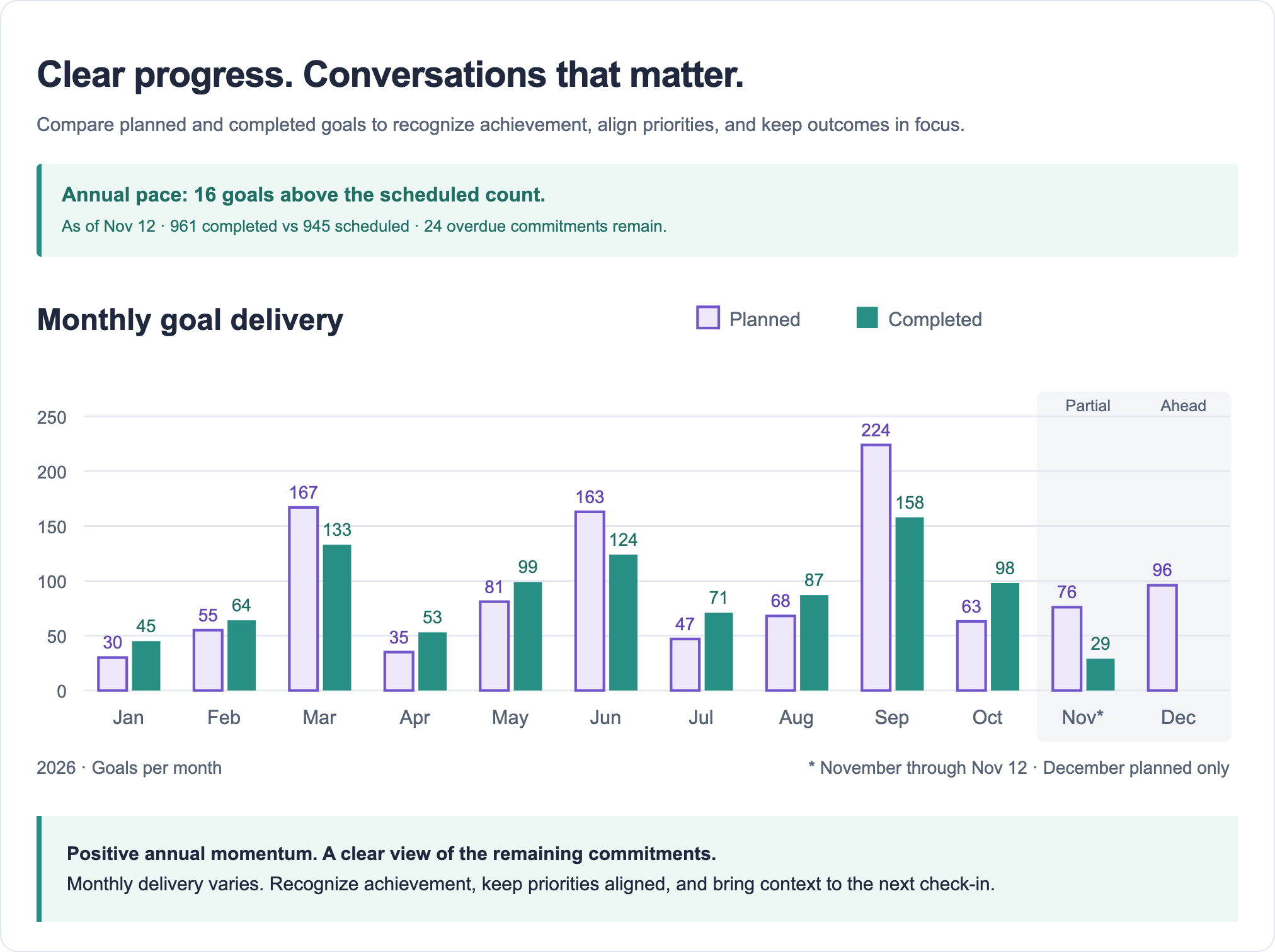
The useful next step is specific: discuss unfinished commitments, clarify ownership, and agree what happens next. Counts guide attention; employees and managers explain significance.
Manage the exceptions—not another spreadsheet
Across hundreds of people, even a strong completion picture can hide work that needs attention. In the illustration, 14 people have no goals and 24 open commitments are overdue. Those are two different follow-up agendas—not a judgment about the people involved.
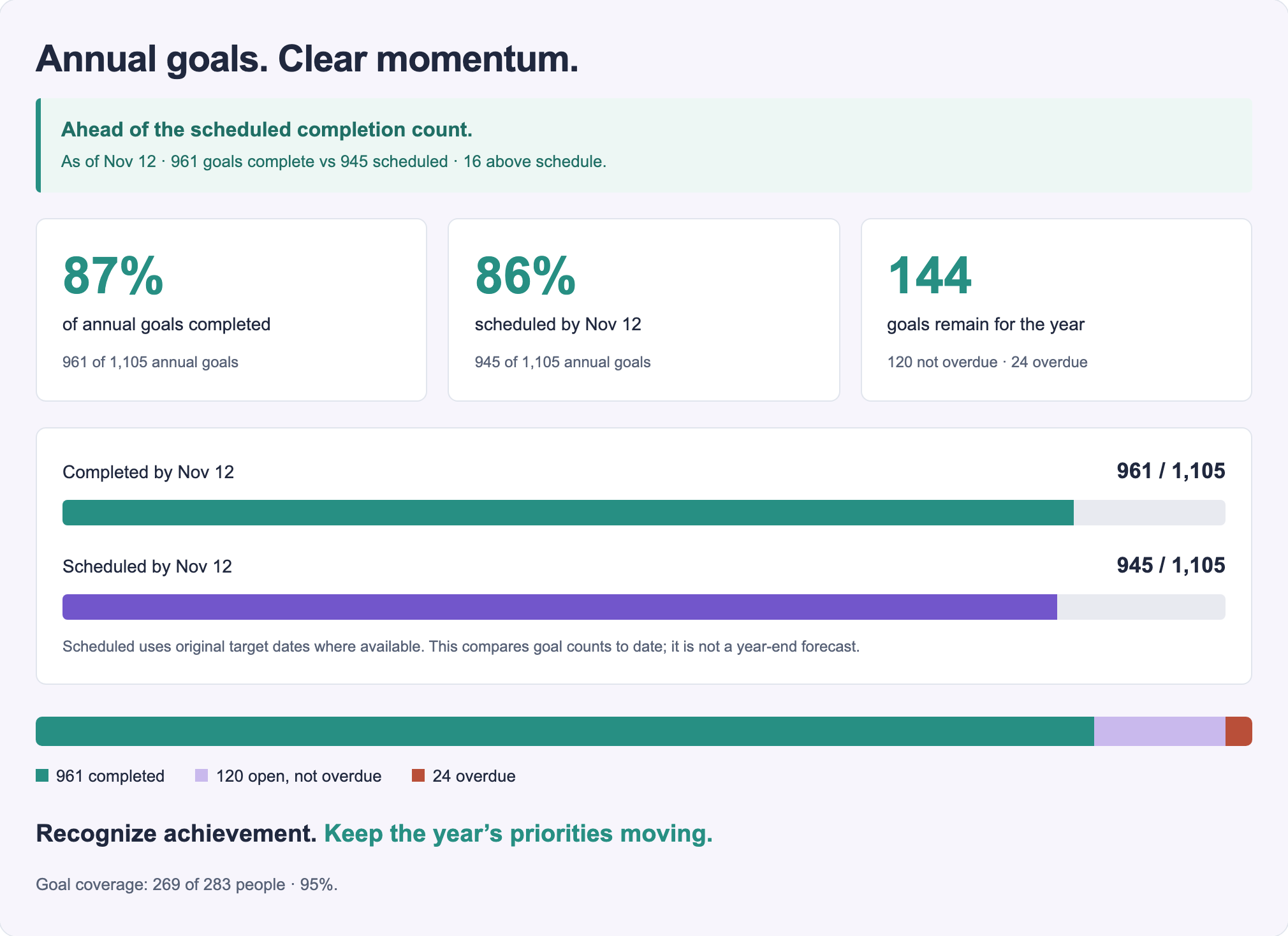
Goal coverage, recorded review input, and sign-offs answer different questions. Bringing them into a shared process gives HR a more practical starting point than reconciling disconnected files. Microsoft Entra ID and Okta SSO, role-based review access, dual digital sign-off, and recorded review actions support access and traceability.
Keep your core HRIS. Modernize the performance experience.
Your existing HR platform remains the authoritative source for core employee records and established HR and payroll processes. Visual Workforce imports supported employee data from your HRIS to support performance workflows alongside it.
The data flow is one-way: from your HRIS into Visual Workforce. Reviews, check-ins, and performance activity are managed in Visual Workforce.
With more than 200 HRIS integrations, supported data varying by connector, you can bring employee context into the performance process without maintaining another employee spreadsheet.
Modernize the process. Keep the history.
Moving to a new performance platform should not mean starting with a blank slate. Visual Workforce supports onboarding data migration to bring in and retain prior-year and current-year performance history, preserving context as your organization adopts its new workflow.
The goal is straightforward: give employees and managers context for the next conversation, and give HR visibility into where follow-up is needed.
Less administration. More accountability. Fewer surprises.
Bring your next review cycle to the demo.
Schedule a personalized live demonstration via Zoom or Microsoft Teams. Bring your employee scale, review cadence, manager workflow, and HRIS requirements—we’ll explore how the process could work for your organization.