
How Do You Build A Skills Matrix?
How to Build a Skills Matrix (With Example)
Updated: March 16, 2026
Most organizations believe they understand the strengths of their workforce. Managers know who the experts are, and teams know who to call when something breaks.
However, clarity often disappears when a simple question is asked: What skills do we actually have across our entire workforce right now?
Many organizations struggle to answer. A skills matrix solves that problem by providing a visual map of which people possess which capabilities—and at what level. This allows leaders to assign work effectively, identify gaps, and plan hiring with confidence.
Curious how this works in practice? Request a demo to see how organizations visualize workforce capabilities in real time.
What Is a Skills Matrix?
A skills matrix is a structured grid that maps individuals against the specific skills required to perform their work.
Rows: Employees or roles.
Columns: Specific skills or competencies.
Cells: The proficiency level (e.g., 1–5).
This simple structure moves leaders from guesswork to total visibility. Instead of wondering if a team can handle a new project, you can see the data instantly.
A Simple Skills Matrix Example
A skills matrix does not need to be complicated to be effective. Even a small table reveals deep insights.
| Team Member | Data Analysis | Process Design | Project Planning | Communication |
|---|---|---|---|---|
| Alex | Advanced | Intermediate | Beginner | Advanced |
| Jordan | Intermediate | Advanced | Intermediate | Intermediate |
| Riley | Beginner | Intermediate | Advanced | Advanced |
| Morgan | Intermediate | Beginner | Intermediate | Advanced |
Patterns appear quickly:
Skill Concentration: You can see if a critical skill (like Data Analysis) lives with only one person.
Development Needs: You can spot where "Beginner" levels might stall a project.
Hidden Strengths: You may find that your "Communication" skills are high across the board, allowing for better client-facing roles.
Stop managing by spreadsheet. Explore a live demo of how Visual Workforce automates these visualizations.
How to Build a Skills Matrix in 5 Steps
Step 1: Identify the Skills That Matter
Start by listing the capabilities your team needs to succeed. Focus on skills that directly influence outcomes—technical expertise, operational knowledge, or leadership.
Tip: Avoid listing every possible skill. A focused list creates much higher clarity.
Step 2: Define Clear Proficiency Levels
To be accurate, you need a consistent scale. Many organizations use a 1–5 framework:
Basic Awareness: Understands the concept.
Novice: Can perform with significant guidance.
Intermediate: Works independently on standard tasks.
Advanced: Can handle complex problems and edge cases.
Expert: Can teach, mentor, and set strategy.
Step 3: Assess Current Capabilities
Evaluate each team member against the framework. Use a mix of:
Manager assessments
Employee self-evaluations
Certifications and project history
Step 4: Build the Matrix
Organize your data into a grid. While many start in Excel, this is where a dynamic platform adds the most value. Manual data becomes "stale" the moment it's entered; a dedicated platform keeps it live.
Want to see a real-time skills matrix in action? Request a demo to see how our platform generates these views automatically.
Step 5: Identify and Close Capability Gaps
Compare your current matrix against your future goals. This reveals:
Single points of failure: (Only one person knows the legacy system).
Cross-training opportunities: (Riley is ready to learn Process Design from Jordan).
Hiring needs: (The whole team is "Beginner" at a new required technology).
Why Traditional Matrices Often Fail
Most organizations begin with spreadsheets. They work initially, but problems appear quickly:
They are static: People learn new skills every week, but the spreadsheet stays the same.
They are siloed: One department’s spreadsheet doesn't talk to another's.
Maintenance burden: Managers stop updating them because it takes too much time.
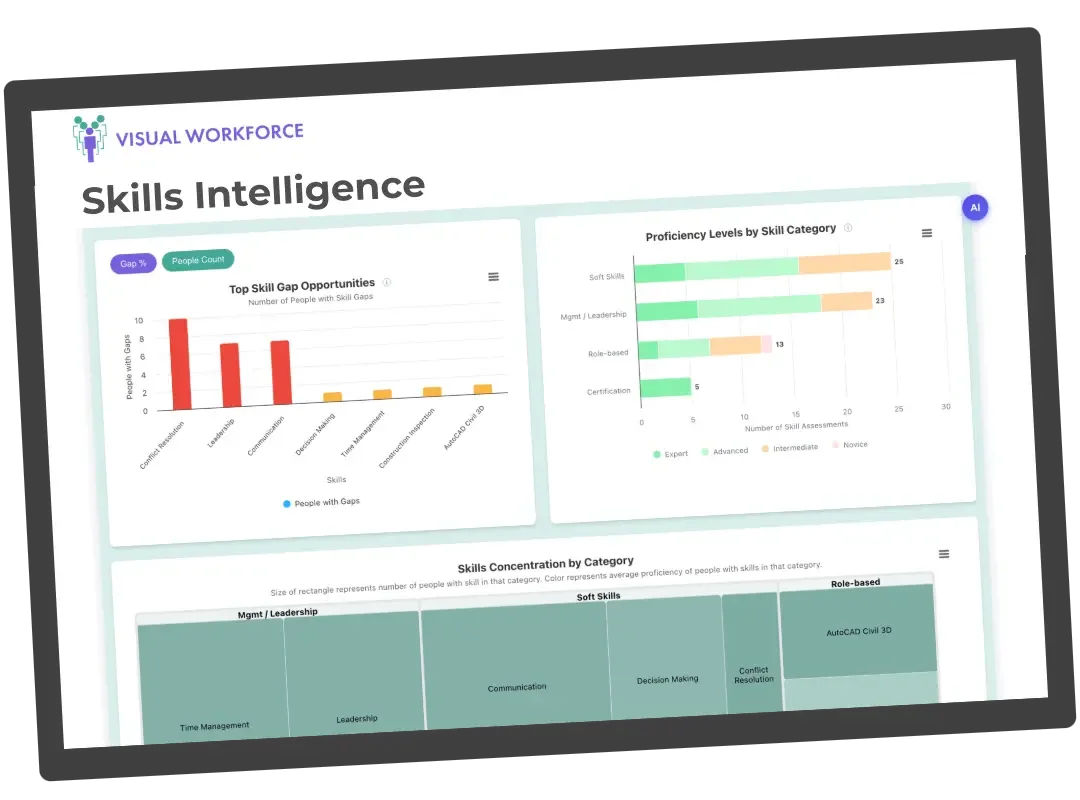
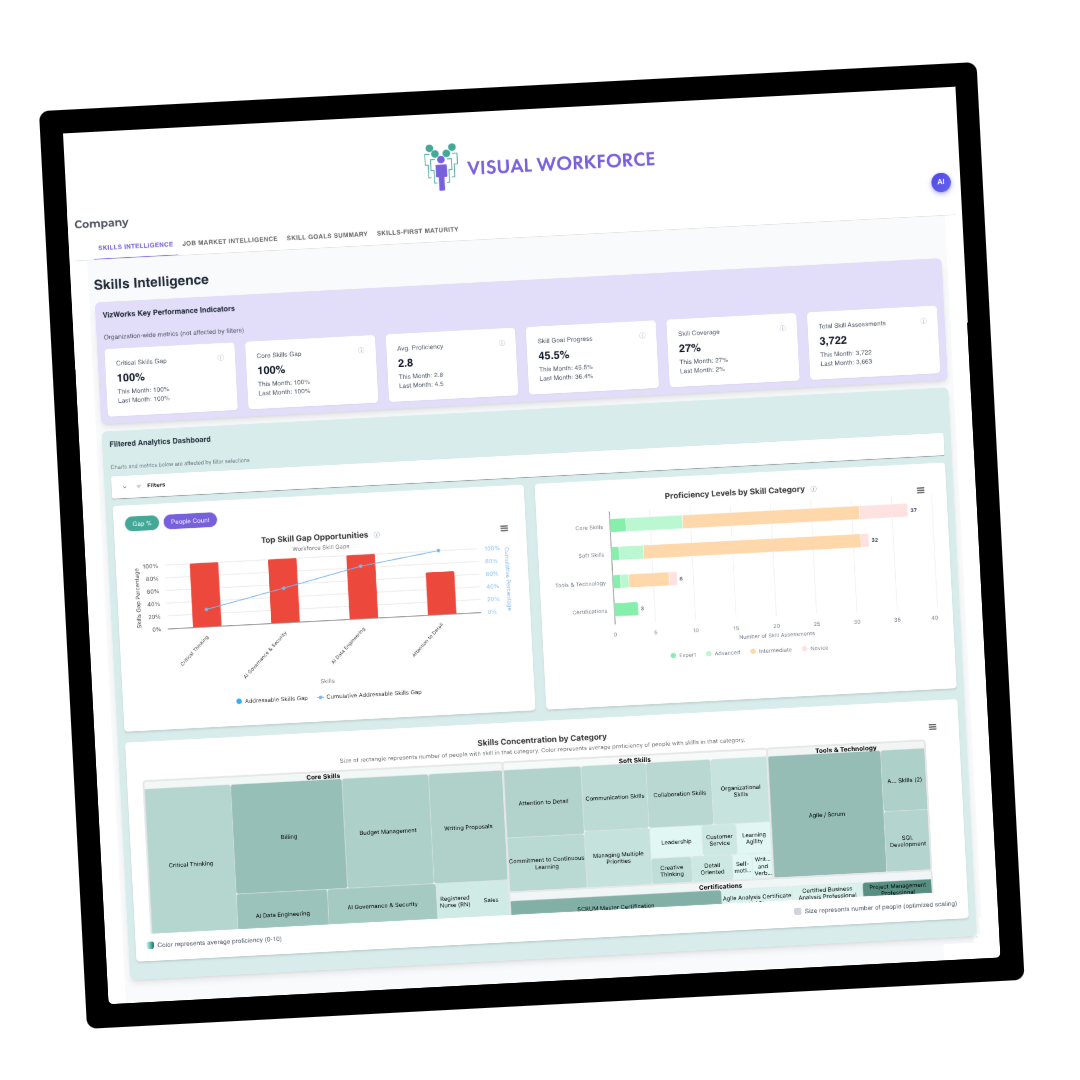
The Solution: Dynamic Skills Intelligence Organizations are increasingly moving toward platforms that continuously track workforce capability. Real-time visibility replaces static documents, turning the skills matrix from a "once-a-year chore" into a daily strategic tool.
Get Your Company's Skills Framework
A skills matrix provides something rare in complex organizations: Clarity. Better visibility leads to stronger planning, smarter development, and more resilient teams. Are you ready to see what your workforce is truly capable of?